| 36 CFR 61 Qualified Professional Archeologists |
 |  |  |  |
STRATA
| 845-647-1390 845-750-3938 info@stratacrm.com |
Federal and State Preservation Legislation
(Excerpted from the New York State Historic Preservation Office (SHPO) where more details are available)
The National Historic Preservation Act of 1966, Section 106
The National Historic Preservation Act of 1966, as amended (16 U.S.C. 470) is the nation's
primary historic preservation law. The act created the National Register of Historic Places, the
official list of properties significant in the history, architecture, archeology and culture of the
United States. The act also called for the creation of State Historic Preservation Offices
(SHPOs) to administer the national program at the state level. In addition, any project that
involves federal funds, licenses or permits is reviewed in accordance with Section 106, which
establishes procedures to be followed by federal agencies whose actions may directly or indirectly
have an effect on historic properties and directs those agencies to consult with SHPO to assess
those effects. Therefore, any approvals/permits/funding that are given by a federal agency must
also be reviewed by SHPO. The comments of an independent review agency, the Advisory
Council on Historic Preservation, may be sought when federal agencies are involved in relevant
undertakings. Examples of federal undertakings include but are not limited to CORPS permits,
FCC permits (cell towers), FDIC approvals/funding (banks, mortgage insurance, etc.), or HUD
funding, etc.
The New York State Historic Preservation Act of 1980, Section 14.09
The New York State Historic Preservation Act of 1980 was established as a counterpart to the
National Historic Preservation Act and declares historic preservation to be the public policy and
in the public interest of the state. The act created the New York State Register of Historic Places,
the official list of sites, buildings, structures, areas or objects significant in the history,
architecture, archeology or culture of the state, its communities or the nation. The act also
requires state agencies to consult with the SHPO if it appears that any projects being planned
may or will cause any change, beneficial or adverse, in the quality of any historic, architectural,
archeological or cultural property that is listed on the National Register of Historic Places or
listed on the State Register or that is determined to be eligible for listing on the State Register. It
requires state agencies, to the fullest extent practicable, consistent with other provisions of the
law, to avoid or mitigate adverse impacts to such properties, to explore all feasible and prudent
alternatives and to give due consideration to feasible and prudent plans that would avoid or
mitigate adverse impacts to such property. The act also establishes agency preservation officers
within state agencies for the purpose of implementing these provisions. In addition, the act
reaffirms and expands the role of the State Board for Historic Preservation, which advises and
makes recommendations to the State Historic Preservation Officer on preservation programs and
activities, including State and National Registers nominations and statewide preservation
planning efforts.
State Environmental Quality Review Act (SEQRA)
The State Environmental Quality Review Act (SEQRA), 6NYCRR Part 617 of the New York State
Environmental Conservation Law, establishes a set of uniform regulations by which all state,
county and local governmental agencies incorporate consideration of environmental impacts into
their planning, review and decision-making processes. Impacts to historic resources, such as
buildings listed on the State or National Registers of Historic Places and archeological sites,
should be taken into account. To accomplish the goal of the act, SEQRA requires that all
governmental agencies determine whether the action they directly undertake, fund or approve
may have a significant impact on the environment. If an action may have a significant adverse
impact, agencies must prepare or request an environmental impact statement. SEQRA applies to
projects undertaken or permitted by county and local governments; consequently, many thousands
of projects statewide that fall outside the purview of the state and national historic preservation
acts are reviewed. New implementing regulations for SEQRA went into effect in 1996. Under this
act, municipalities may request that a project be reviewed by the SHPO. All SHPO comments
under this review are advisory only.
.
(Excerpted from the New York State Historic Preservation Office (SHPO) where more details are available)
The National Historic Preservation Act of 1966, Section 106
The National Historic Preservation Act of 1966, as amended (16 U.S.C. 470) is the nation's
primary historic preservation law. The act created the National Register of Historic Places, the
official list of properties significant in the history, architecture, archeology and culture of the
United States. The act also called for the creation of State Historic Preservation Offices
(SHPOs) to administer the national program at the state level. In addition, any project that
involves federal funds, licenses or permits is reviewed in accordance with Section 106, which
establishes procedures to be followed by federal agencies whose actions may directly or indirectly
have an effect on historic properties and directs those agencies to consult with SHPO to assess
those effects. Therefore, any approvals/permits/funding that are given by a federal agency must
also be reviewed by SHPO. The comments of an independent review agency, the Advisory
Council on Historic Preservation, may be sought when federal agencies are involved in relevant
undertakings. Examples of federal undertakings include but are not limited to CORPS permits,
FCC permits (cell towers), FDIC approvals/funding (banks, mortgage insurance, etc.), or HUD
funding, etc.
The New York State Historic Preservation Act of 1980, Section 14.09
The New York State Historic Preservation Act of 1980 was established as a counterpart to the
National Historic Preservation Act and declares historic preservation to be the public policy and
in the public interest of the state. The act created the New York State Register of Historic Places,
the official list of sites, buildings, structures, areas or objects significant in the history,
architecture, archeology or culture of the state, its communities or the nation. The act also
requires state agencies to consult with the SHPO if it appears that any projects being planned
may or will cause any change, beneficial or adverse, in the quality of any historic, architectural,
archeological or cultural property that is listed on the National Register of Historic Places or
listed on the State Register or that is determined to be eligible for listing on the State Register. It
requires state agencies, to the fullest extent practicable, consistent with other provisions of the
law, to avoid or mitigate adverse impacts to such properties, to explore all feasible and prudent
alternatives and to give due consideration to feasible and prudent plans that would avoid or
mitigate adverse impacts to such property. The act also establishes agency preservation officers
within state agencies for the purpose of implementing these provisions. In addition, the act
reaffirms and expands the role of the State Board for Historic Preservation, which advises and
makes recommendations to the State Historic Preservation Officer on preservation programs and
activities, including State and National Registers nominations and statewide preservation
planning efforts.
State Environmental Quality Review Act (SEQRA)
The State Environmental Quality Review Act (SEQRA), 6NYCRR Part 617 of the New York State
Environmental Conservation Law, establishes a set of uniform regulations by which all state,
county and local governmental agencies incorporate consideration of environmental impacts into
their planning, review and decision-making processes. Impacts to historic resources, such as
buildings listed on the State or National Registers of Historic Places and archeological sites,
should be taken into account. To accomplish the goal of the act, SEQRA requires that all
governmental agencies determine whether the action they directly undertake, fund or approve
may have a significant impact on the environment. If an action may have a significant adverse
impact, agencies must prepare or request an environmental impact statement. SEQRA applies to
projects undertaken or permitted by county and local governments; consequently, many thousands
of projects statewide that fall outside the purview of the state and national historic preservation
acts are reviewed. New implementing regulations for SEQRA went into effect in 1996. Under this
act, municipalities may request that a project be reviewed by the SHPO. All SHPO comments
under this review are advisory only.
.
| 36 CFR 61 Qualified Professional Archeologists |
Will my project need an archeological review?
Check to see if your project location falls within an area determined by the State
Historic Preservation Office to be archeologically sensitive by clicking HERE.
If your project is within an archaeologically sensitive area (map updated frequently)
and involves State and/or Federal funding, requires State and/or Federal permits or
State Environmental Quality Review, then it is very likely that you will be required to
hire a 36 CFR 61 Qualified Professional Archeologist to determine what if any
impacts your project may have on the State's historic and/or archeological resources.
Check to see if your project location falls within an area determined by the State
Historic Preservation Office to be archeologically sensitive by clicking HERE.
If your project is within an archaeologically sensitive area (map updated frequently)
and involves State and/or Federal funding, requires State and/or Federal permits or
State Environmental Quality Review, then it is very likely that you will be required to
hire a 36 CFR 61 Qualified Professional Archeologist to determine what if any
impacts your project may have on the State's historic and/or archeological resources.
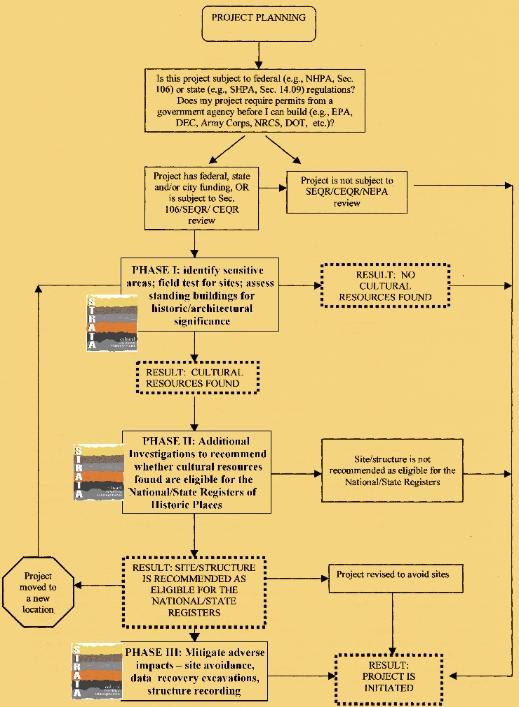
| Base flow chart from page 3 of the New York Archaeology Council publication entitled: CULTURAL RESOURCE STANDARDS HANDBOOK Click chart to access handbook. |